Built Work -- the proof corridor
Six capability lanes. Each one with receipts.
AI agents, data systems, and whole organizations, built by hand. Each lane below states the problem in one line, what got built, why the choices mattered, and a receipt that backs the claim. Client names, quotes, and metrics appear only with consent.
Lane 01
AI Agent Infrastructure
An agent that represents the business, answers, and acts with approval -- an employee who never sleeps. Troy builds these for clients, not only for himself: each one is calibrated to a real voice and a real scope, wired to real infrastructure, and built so the business owns it.
t.ROY -- Midnight Desk
Problem: a one-operator practice loses the deals that decide at midnight, because no one is there to answer.
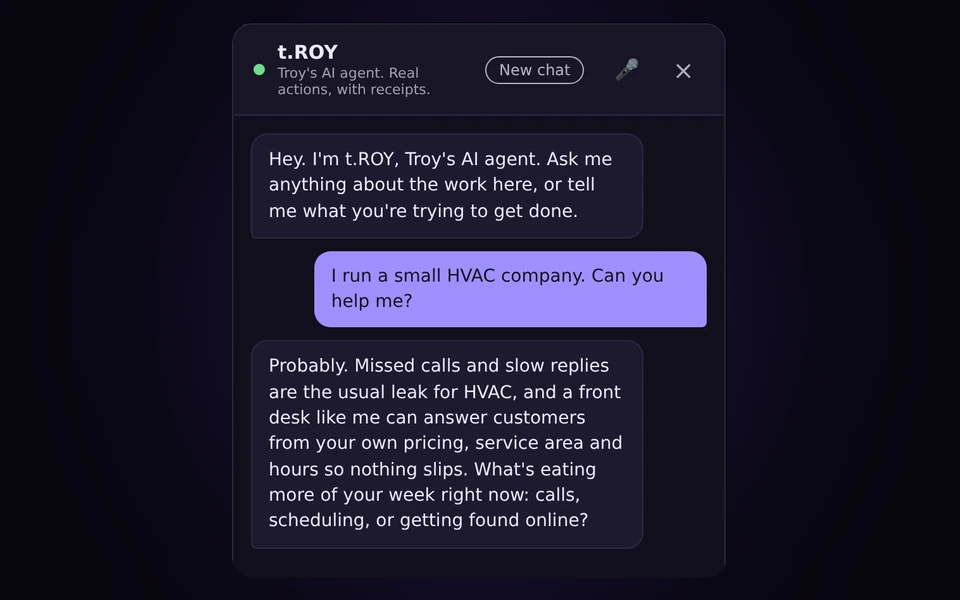
A full-stack AI front desk, not a FAQ bot. One session-aware brain across web chat and an SMS line, wired to Twilio, Google Calendar, Gmail, and Resend. It qualifies, answers in Troy's voice, books meetings, and queues anything past its scope instead of guessing.
Why it mattered: availability stopped being a bottleneck. Troy wakes up with context, not missed deals, and it is the same pattern he builds for clients with an inbound problem.
Casa Noble -- restaurant agent
Problem: a busy restaurant cannot field every hours, menu, and reservation question that comes in after the floor gets loud.
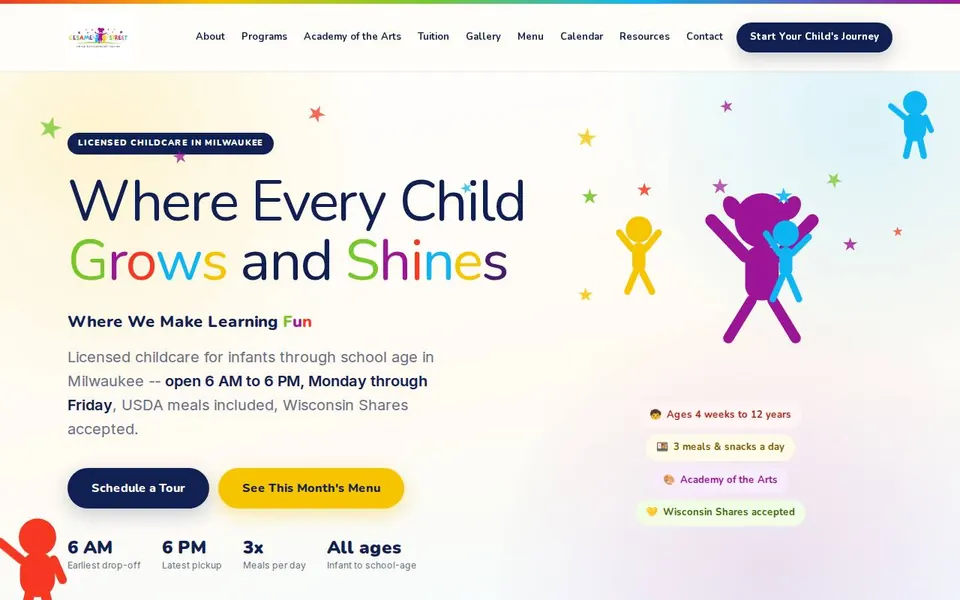
An on-site assistant trained on the restaurant's own menu, hours, and bilingual EN and ES voice. It answers guests in seconds and hands off cleanly when a human is needed, so the team stays on the floor instead of on the phone.
Why it mattered: the same agent pattern, fitted to a completely different business. Built for the client, in the client's voice, not a generic widget bolted on.
Brand Station -- client agents
Problem: a personal brand should be able to answer for itself, not just sit on a card.
Live AI assistants embedded in client Brand Station platforms, each grounded in that client's own brand bible so it speaks in their voice and never makes claims they have not approved. The brand answers questions, points people to the right thing, and captures the lead.
Why it mattered: every client gets the agent, not just Troy. The AI he builds for himself is the same caliber he ships to the people he works with.
AI governance advisory
Problem: organizations want to use AI responsibly, but few have rules for who AI may speak for, what it may decide, and how it stays accountable.
Technology and digital-strategy advisory to an organization in the criminal-justice sector, including the site and a governance portal. AI governance is the discipline of setting those rules: where a human stays in the loop, how consent and privacy are enforced, and how every AI action leaves a record you can audit. Troy builds those guardrails into the systems themselves. He advises; the organization leads.
Why it matters: AI without governance is a liability. Trust comes from limits and receipts, and that is what gets designed in from the start.
In her own words, on responsiveness: Brianne Birtic, LCSW, of Beautiful Minds Therapy put it plainly -- "He responds in a timely manner, and by timely, I mean within minutes. Literally." A real agent earns that reputation; so does the person who builds it.
Lane 02
Data Products
Here is the part most people miss: an AI is only as good as the facts it can stand on. Ask it about your market and it will guess, and a guess that sounds confident is a hallucination. Troy writes code that reads the open web for real, verifiable connections -- organizations, people, relationships -- then scores, dedupes, and tags each one back to its source. The result is a dataset the AI can cite instead of invent, and a network you can actually act on. This is writing software to find the truth, not running a Google search.
Acquisition Engine
Problem: mission organizations need a network they cannot afford to research by hand.
A reusable acquisition pipeline that seeded 2,400-plus Midwest reentry and workforce organizations from public records, then deep-swept and scored hundreds with provenance tagging on every record.
Why it mattered: warm-network intelligence without cold-calling. The same pipeline becomes a refreshable dataset rather than a one-time list.
Statewide Eligibility Analysis
Problem: a justice nonprofit needed thousands of records screened down to a defensible candidate list.
A paid data engagement: a statewide commutation-eligibility analysis, thousands of records screened into a verified candidate list, with a quarterly-refresh model proposed.
Why it mattered: this is the proof point for data as a product -- a recurring dataset relationship, not a single export.
Dataset Curation
Problem: raw data is not a product until it is organized, enriched, and trustworthy.
Whole datasets organized and enriched with custom-written research scripts, deduped, and tagged so each row can be traced to its source. Stored on Neon Postgres and SQLite with pgvector for semantic retrieval.
Why it mattered: shareable, refreshable datasets nonprofits, foundations, and consultants can actually use.
Lane 03
Reentry & Housing Infrastructure
Reentry, housing, and workforce each have their own people, rules, and pain. Troy learned them one at a time, on their own terms, with the organizations doing the work. Then he found where they overlap -- a person leaving incarceration who needs housing, a referral, and a job at once -- and built the connecting infrastructure there, so every party gains from the same system instead of each rebuilding it alone.
MKE Reentry Housing Hub
Problem: Milwaukee's reentry-housing gap was scattered across phone calls and word of mouth.
A coalition-built resource navigator at mkereentryhub.com: a provider directory, tenant intake, referral tracking, and a training track, built with Dr. LaTonya Baker's organization.
Why it mattered: the city's reentry housing, in one searchable place. A build Troy is proud of, contributed to the coalition.
Housing Verification
Problem: a commutation cohort needed housing claims verified before a release plan could stand.
A housing-verification operations tool for a Wisconsin commutation cohort, with cascading model checks and confidence scoring. A volunteer build.
Why it mattered: verification you can defend in a setting where a wrong answer has a human cost.
Waukesha Resource Navigator
Problem: residents and caseworkers had no single map of county services.
A community navigation platform: 119 organizations, 31 database tables, AI-powered eligibility matching and referral routing. Built by one operator as a coalition contribution.
Why it mattered: one platform replaced a stack of PDFs and phone trees.
Lane 04
Healthcare & Behavioral Health Visibility
Healthcare is different, and it is treated that way. These practices serve vulnerable people, so privacy is the foundation, not a footnote: HIPAA and 42 CFR Part 2 inform how intake routes, how data is handled, and how TMG is architected to never touch protected health information. On top of that foundation Troy designs marketing and sales funnels built for the industry -- referrer hubs, intake paths, and answer-engine-ready pages that fit how patients and referring clinicians actually decide.
Evolving Minds Psychiatry
Problem: a psychiatric NP hired three vendors and still felt unheard, with her older work lost to the archive.
Nine pages rewritten one paragraph at a time in her actual voice, fourteen vanished posts recovered from the Internet Archive into a permanent /legacy archive, and a private review-tool channel.
Why it mattered: her patients land on a page that sounds like her, not a clinic from a box. Verified testimonial on file.
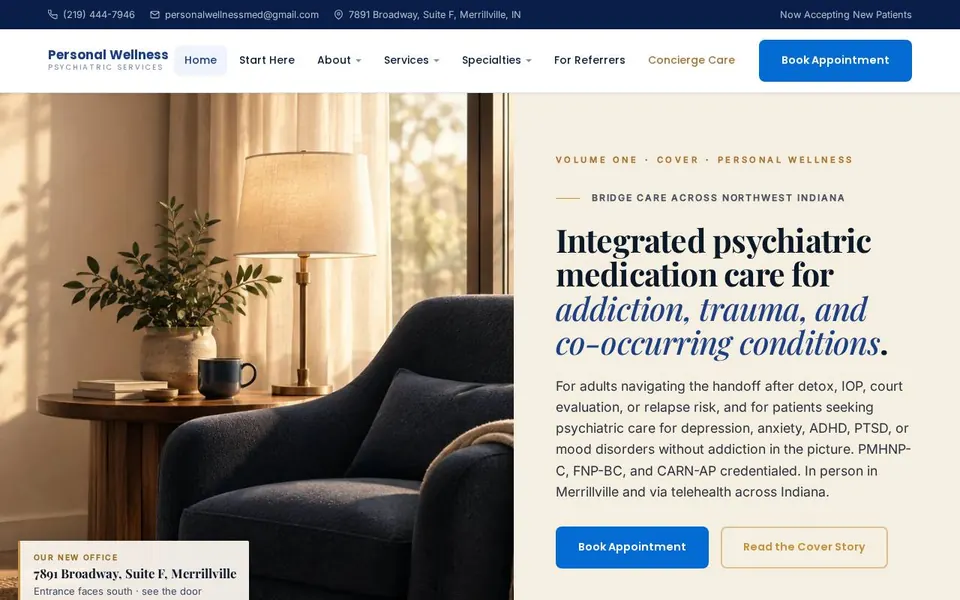
Personal Wellness Psychiatric Services
Problem: an integrated addiction-trauma-psychiatry practice was being read as a generic clinic.
An editorial Volume One redesign plus a five-page referrer hub, a 12-page Bridge Care Guide PDF, and HIPAA-aware intake routed so TMG never touches PHI.
Why it mattered: a primary-care provider now sends referrals through the hub. The site does operational work, not brochure work.
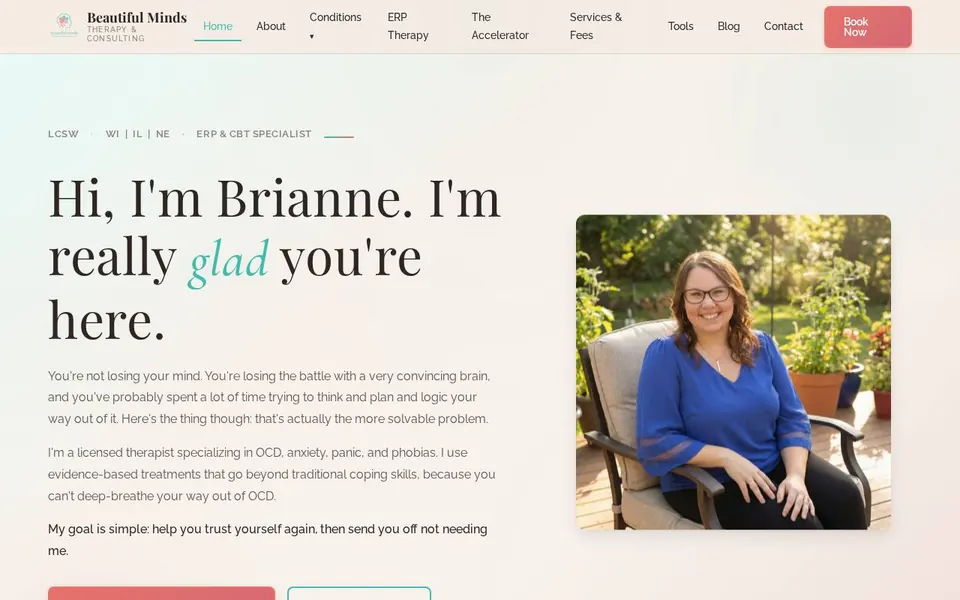
Beautiful Minds Therapy
Problem: a clinical OCD practice needed to be findable, credible, and genuinely useful, not template content.
A multi-page clinical site with eight custom interactive clinical tools, built compliance-aware for HIPAA, ADA, and 988.
Why it mattered: tools, not filler. Brianne Birtic, LCSW: "I am so proud to show off the work he has done for me." Consented for this surface.
What the work earns is trust. Nkemdilim Nwofor, PMHNP-BC, of Evolving Minds Psychiatry, after three other vendors: "I literally wanted to cry when I saw my own voice on my page. I did not feel manipulated or gaslighted. I feel mentally safe with him as a long term partner." That is the bar in healthcare, and it is the same bar everywhere else.
Lane 05
Brand & Sales Systems
Before a single page is built, Troy writes a robust brand bible for nearly every client -- their images, mission, vision, purpose, and goals, captured as canonical truth and stored in a version-controlled repo. The product is then built on top of that bible, so every word, color, and decision rests on the client's own documented truth instead of a guess. It is also what keeps the brand alive: the system carries it, not a one-time deliverable.
Brand Station
Problem: a personal brand dies the moment it becomes a static card no one updates.
A personal-brand platform with live AI tools and a real portal, plus a per-client living brand bible: a version-controlled doctrine that governs everything built on top of it.
Why it mattered: a brand that stays alive because the system, not a one-time deliverable, carries it.
The Magnetic Remembering
Problem: a mentorship offer needed to feel like an initiation, not a SaaS marketing page.
A dark-immersive three-tier mentorship platform with affiliate integration and an application-to-email pipeline.
Why it mattered: a real sales funnel that matches the work it is selling.
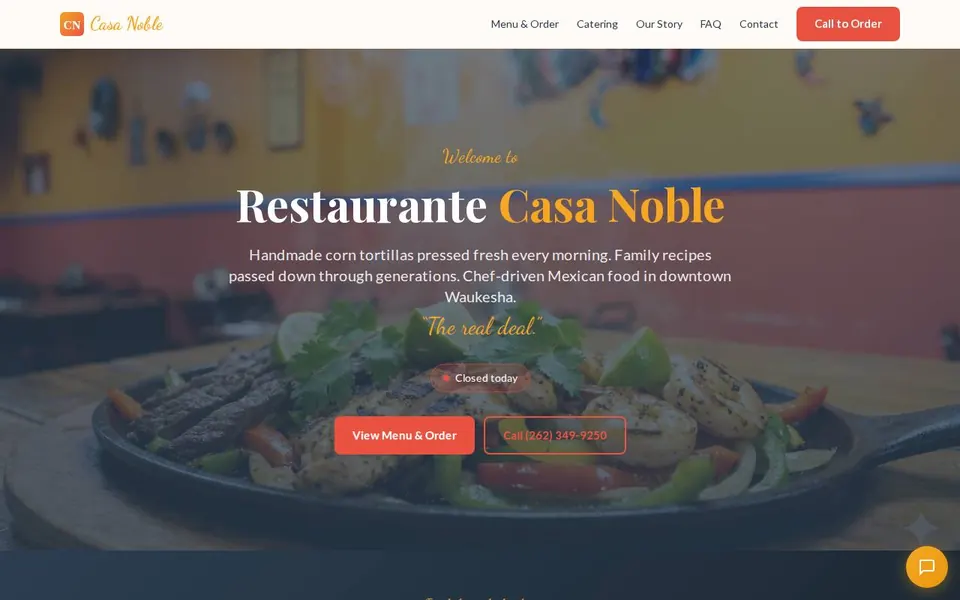
Casa Noble
Problem: an operator should never have to call a developer to update a menu.
A full bilingual EN/ES restaurant rebuild with a portal-publish flow: one action updates the site and socials at once.
Why it mattered: the owner owns the publishing, not the vendor.
Lane 06
Research & Authority
Troy has made research a core discipline, and he uses it the same way he uses data: to cut hallucination out of the work. He does his own research and checks it deeply, because a confident claim with no source is worthless. He also reads a subject's history as carefully as its present -- knowing how something came to be is what gives you any real shot at where it is going. The method is published, so the claims can be checked.
What Makes AI Name You
Problem: nobody could say, with evidence, why an AI answer engine names one business and skips another.
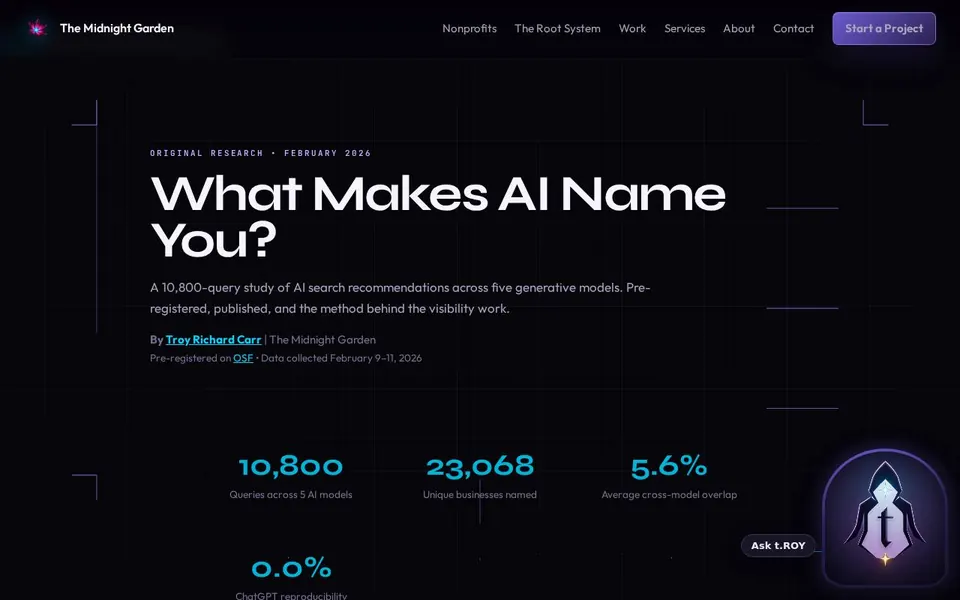
An original study: 10,800 queries across five AI models and eighteen cities, pre-registered on the Open Science Framework, and published with full methodology.
Why it mattered: the visibility service rests on research, not on adjectives. The method existed nowhere, so it was built before it was sold.
Forge Design Brief
Problem: building career tools for justice-impacted people demands evidence, not assumptions.
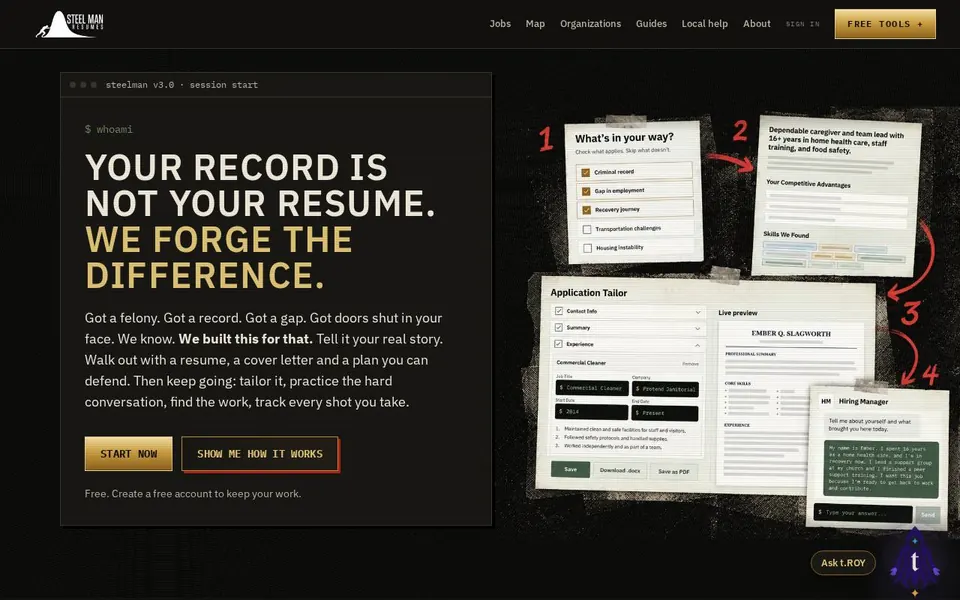
A 33,543-word design brief grounded in more than 150 peer-reviewed citations, behind the Forge and the Refinery on Steel Man Resumes.
Why it mattered: the product is built on a literature base, which is also why the Crucible reached national-conference selection.
The point of all of it
Across six lanes, the work is the same promise kept: build the room, in the client's own voice, and stay for what comes next. As Angela Vanderberg, PMHNP-C, wrote in the cover story for her own practice site: "That gap is the practice. Bridge care is the work the field calls 'complicated' and quietly routes elsewhere." TMG builds for exactly that work -- the part the field skips -- and the people who choose to do it well.
Pick the loss first; the offer follows
Want this for your business?
Start with the loss you want gone first. The application drafts itself from there, and Troy reads every one.